
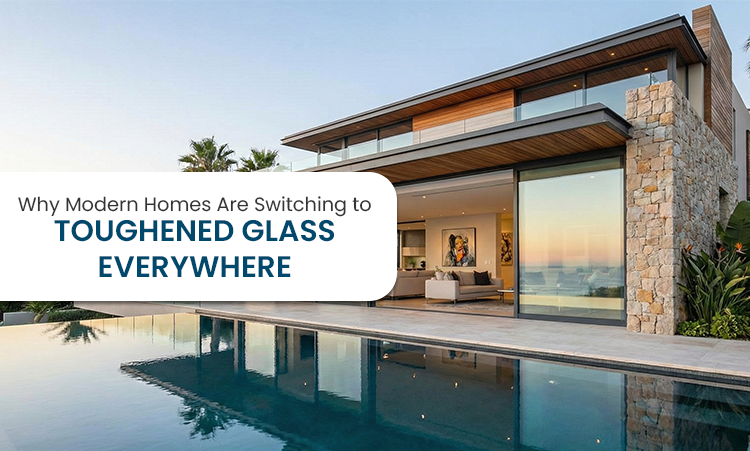
Why Modern Homes Are Switching to Toughened Glass Everywhere
Walk into a newly built home today and you'll notice something quietly different. More light. Fewer heavy walls. Staircases that feel open instead of boxed in. Balconies that don't block the view. Doors that don't divide space aggressively.
Glass is doing a lot of that work. And not just any glass. Toughened glass for homes has slowly become the default in many modern designs. This shift didn't happen because it looks trendy. It happened because it solves real design and structural problems at the same time.
Homes Are Getting Brighter and More Open
Older homes relied heavily on thick walls and smaller openings. Privacy was built through separation. Modern homes are doing the opposite. They try to maximise natural light. They reduce visual barriers. They make even compact spaces feel larger than they are.
Toughened glass doors and partitions allow rooms to stay connected without losing definition. You still have separate areas, but they don't feel closed off. This is especially noticeable in duplex homes and villas where staircases are now often paired with glass railings for homes instead of metal grills or solid walls. The space instantly feels lighter.
Architectural trends across global residential design reflect this preference for openness and transparency, which you can see in various modern housing projects featured on ArchDaily. But design alone isn't enough. Strength matters too.
Safety Expectations Have Increased
Homeowners today ask more questions.
What happens if the glass breaks?
Is it safe for children?
Can it handle impact?
Regular glass does not answer those questions well. Toughened glass does.
Toughened glass for homes is heat-treated to increase strength. When stressed beyond its limit, it breaks into small blunt pieces rather than sharp shards. That alone changes the safety equation inside homes. This is why it's now common in balcony railings, shower enclosures, staircase panels, and even large sliding doors. The decision is practical before it is aesthetic.
Modern Interiors Prefer Clean Lines
Heavy frames are slowly disappearing from interior design. People prefer minimal hardware, frameless doors, and seamless partitions. Toughened glass allows that because it can handle stress without thick support structures everywhere.
Modern glass interiors rely on this property. You can have larger panels without bulky frames cutting through the view. This is why even wardrobes, kitchen partitions, and office rooms inside homes are increasingly using glass rather than wood or metal. It makes spaces feel contemporary without adding visual weight.
Maintenance Has Become More Manageable
One concern people had earlier was maintenance. Glass shows fingerprints. It shows dust. It needs cleaning. That hasn't changed. What has changed is surface finishing and installation quality. Properly installed toughened glass with smooth edges and good hardware is easier to maintain than painted metal that chips or wood that absorbs moisture.
In humid environments especially, glass often ages better visually than many traditional materials. It doesn't rust. It doesn't swell. It doesn't peel. That reliability is part of the reason more homeowners are switching.
Outdoor and Indoor Use Are Blending
Balconies are no longer purely external zones. They are extensions of living spaces. Glass railings for homes allow outside views to remain uninterrupted. In apartments overlooking greenery or cityscapes, this matters a lot.
The same logic applies to terrace enclosures and large window systems. Toughened glass doors allow smooth transitions between indoor and outdoor without feeling like a barrier. Homes are being designed around continuity, not separation. Glass supports that idea naturally.
It's Not About Using Glass Everywhere Without Thought
Not every corner needs glass. Bedrooms may need more privacy. Certain structural areas require different materials. Glass works best when placed intentionally.
The reason modern homes are switching to toughened glass everywhere is not excess. It's controlled integration. It is used where light, openness, and strength align. That balance is what makes it feel modern rather than overwhelming.
How Tufftron Approaches Toughened Glass for Homes
At Tufftron, toughened glass is treated as a structural component, not just a finishing layer. Before recommending toughened glass doors or glass railings for homes, we look at where the installation will sit, how it will be supported, and how people will interact with it daily.
Modern homes are shifting to have more openness. But openness should never come at the cost of durability. That balance between design and safety is what makes toughened glass a long-term choice rather than a temporary trend.
Closing Thought
Modern homes are not switching to toughened glass because it's fashionable. They are choosing it because it performs.
It opens space. It strengthens structures. It supports clean design. And when chosen correctly, it lasts. Glass today is not just decorative. It has become part of how homes function. And that shift is unlikely to reverse anytime soon.